How to Play Hand and Foot: Complete Rules in Plain English
November 2, 2026
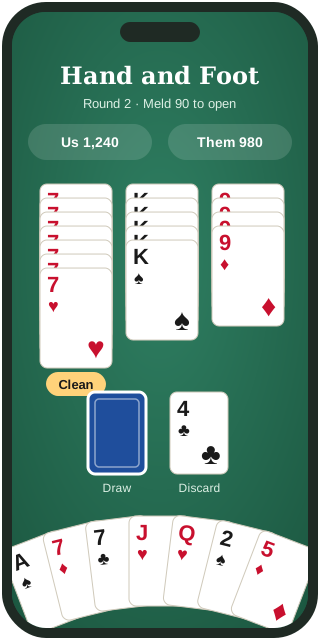
Hand and Foot is a rummy-style card game in the Canasta family. You play in teams of two, and you try to build “books”: stacks of seven cards of the same rank. The twist is that every player has two piles of cards. You play your hand first, then pick up your foot and keep going.
Every club and family seems to play it a little differently. The rules below are the most common way to play. Where tables often differ, we say so.
Quick summary
- 4 players in 2 teams. Partners sit across from each other.
- Each player gets a hand of 11 cards and a foot of 11 cards.
- On your turn: draw 2, make melds if you can, then discard 1.
- Build books of 7 cards of the same rank. A clean book (no wild cards) is worth more than a dirty one.
- Play all of your hand, then pick up your foot.
- To go out, your team needs a set number of books, and you need your partner’s okay.
- Play four rounds. The opening meld gets harder each round. Highest total score wins.
What you need
For 4 players, use 5 standard decks with jokers shuffled together (one more deck than players). Some tables use 6 decks. You also need a pencil and a score sheet.
The deal
Each player takes two stacks of 11 cards:
- The first 11 cards are your hand. Pick it up.
- The next 11 cards are your foot. Leave it face down in front of you. Don’t look at it.
Put the rest of the cards face down in the middle as the draw pile. Turn the top card over to start the discard pile.
Card values
Every card you play is worth points at the end of the round. Every card left in your hand or foot counts against you.
| Card | Points |
|---|---|
| Joker | 50 |
| 2 (wild) | 20 |
| Ace | 20 |
| King through 8 | 10 |
| 7 through 4 | 5 |
| Black 3 | 5 |
| Red 3 | 100 (see below) |
Wild cards
Jokers and 2s are wild. You can use them in place of any card from 4 through Ace. Most tables say a meld must always have more natural cards than wild cards, and some limit a meld to three wild cards.
Your turn
- Draw the top 2 cards from the draw pile.
- Meld, if you can. A meld is 3 or more cards of the same rank, such as three 9s, laid face up in front of your team. Suits don’t matter. You can also add cards to melds your team already has on the table.
- Discard one card face up on the discard pile.
Partners share one set of melds. Anything you lay down helps your partner, and the other way around.
The opening meld
The first time your team lays down cards in a round, the cards you put down together must add up to a minimum score:
| Round | Points needed to open |
|---|---|
| 1 | 50 |
| 2 | 90 |
| 3 | 120 |
| 4 | 150 |
Once one partner has opened, the other partner doesn’t need to meet the minimum.
Books: clean and dirty
A meld becomes a book when it reaches 7 cards. Square it up into a pile so everyone can see it is finished.
- A clean book (also called a red book or natural book) has no wild cards. It is worth 500 points.
- A dirty book (black book) has at least one wild card. It is worth 300 points.
Some tables also allow a book made only of wild cards, often worth 1,500 points.
Threes
Threes can’t be used in melds.
- Black 3s are a safe discard. When a black 3 is on top of the discard pile, nobody can pick up the pile.
- Red 3s count for your team. Many tables have you lay a red 3 face up as soon as you get it and draw a replacement. It scores 100 points at the end of the round, but if a red 3 is still in your hand or foot when someone goes out, it counts minus 100.
How red threes work is one of the rules that changes most from table to table, so agree on it before you start.
Picking up the discard pile
Instead of drawing 2 cards, you can take the discard pile if you hold two natural cards that match the top card. Lay those two cards and the top card down as a meld (it must meet the opening minimum if your team hasn’t opened yet), then take the next 6 cards from the pile into your hand. Some tables let you take the whole pile.
You can’t pick up the pile when a black 3 or a wild card is on top.
Picking up your foot
When you have played every card in your hand, pick up your foot and keep playing.
- If you used up your hand by melding, pick up your foot right away and continue your turn.
- If your last card was a discard, pick up your foot and wait for your next turn.
Going out
The round ends when one player goes out. To go out:
- You must be playing from your foot.
- Your team must have the required books. The most common rule is 2 clean books and 2 dirty books. Some tables ask for more.
- You must ask your partner, “May I go out?” If your partner says yes, you must go out. If they say no, you can’t go out on that turn.
- You play or discard your last card.
Going out earns your team a 100-point bonus.
Scoring a round
When someone goes out, each team adds up:
- Books: 500 for each clean book, 300 for each dirty book.
- Cards on the table: the point value of every card in your melds and books.
- Red 3s: plus 100 each if laid down, minus 100 each if still in a hand or foot.
- Going out: plus 100 for the team that went out.
- Cards left over: subtract the value of every card still in each player’s hand and foot.
Write the total on your score sheet. After four rounds, the team with the highest total wins. Need one? Print our free Hand and Foot score sheet.
Common house rules
Before you deal, settle these at your table:
- How many decks: 5 or 6?
- How many books to go out, and how many must be clean?
- How red threes are scored.
- How many cards you take when you pick up the pile: 6 or the whole pile?
- Whether a wild-card book is allowed, and what it’s worth.
In our Hand and Foot app you can set each of these and save them as “My table’s rules,” so the computer players play the way your family does.
More Hand and Foot guides
Red Threes in Hand and Foot: Rules, Points and House Rules
What to do with a red three in Hand and Foot: when to lay it down, how much it scores, the penalty if it's stuck in your foot, and 4 common house rules.
November 2, 2026
How to Score Hand and Foot: Points, Books and a Worked Example
Step-by-step Hand and Foot scoring with card values, clean and dirty books, red threes and a full worked example. Free printable score sheet included.
November 2, 2026