How to Solve a Star Battle Puzzle Step by Step (6×6 Example)
November 2, 2026
The best way to learn a logic puzzle is to watch one get solved. In this guide we’ll solve a small 6 × 6 Star Battle board together, one step at a time, with a picture at every stage. In Porch Cats you place sleeping cats instead of stars, so that’s what you’ll see here.
You won’t need to guess once. Every move comes from one of three simple ideas, and by the end you’ll be able to spot them on your own.
The rules in one minute
Place cats so that:
- Every row has exactly one cat.
- Every column has exactly one cat.
- Every colored region has exactly one cat.
- Cats never touch, not even at the corners.
We’ll call rows 1 to 6 from top to bottom and columns 1 to 6 from left to right. An × means “no cat can go here.”
If you’d like the rules with more pictures first, see how to play Star Battle.
The puzzle
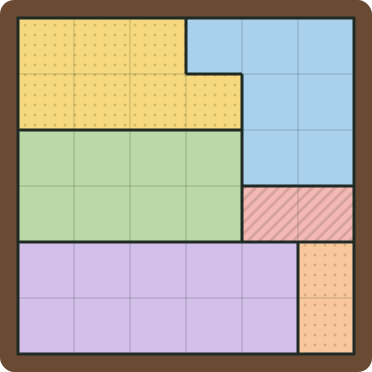
Six regions: yellow and blue across the top, green in the middle, a small pink region of two squares in row 4, a big lavender region along the bottom, and a small peach region of two squares in column 6.
Before you do anything, look for the smallest regions. Small regions have the fewest choices, so they’re where the puzzle starts.
Step 1: Regions stuck in one line
Pink has only two squares, and both are in row 4. Pink needs a cat, so row 4’s cat must be one of those two pink squares. That means every other square in row 4 is an ×.
Now look at green. Green covers rows 3 and 4, but we just crossed out all of green’s row 4 squares. So green’s cat must be in row 3, which means the two blue squares at the end of row 3 are ×.
Peach has two squares, both in column 6. Same idea: column 6’s cat must be in peach, so every other square in column 6 is an ×.
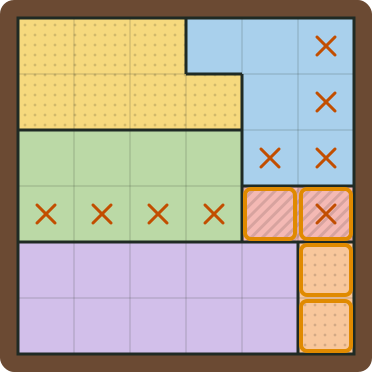
This is the most useful move in Star Battle: if a region fits in one row or one column, the rest of that row or column is crossed out. Always check for it first.
Step 2: Squares with no other choice
Look at row 4 again. Only two squares are open, both pink, and the one in column 6 is now an ×. So the cat goes in row 4, column 5.
Place it, then cross out everything it rules out: the rest of its row and column, the rest of pink, and the eight squares touching it.
That cat touches row 5, column 6. So the only open square left in column 6 is row 6, column 6. Place a cat there too.
Now check blue. Most of it is crossed out: column 6 went in step 1, and column 5 is taken by our first cat. Only row 1, column 4 is left. Third cat.
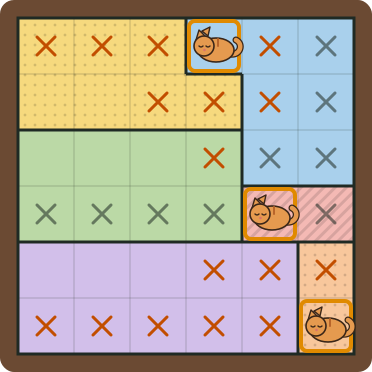
Every time you place a cat, cross out around it right away. It’s the habit that keeps the puzzle moving.
Step 3: The “what if” test
Now it looks like we’re stuck. Row 2 has two open squares, columns 1 and 2. Which one?
Try one in your head. What if the cat went in row 2, column 2? It would touch row 3, columns 1, 2 and 3. Those are the only open squares left in row 3. Row 3 would have nowhere to put its cat, so that can’t be right.
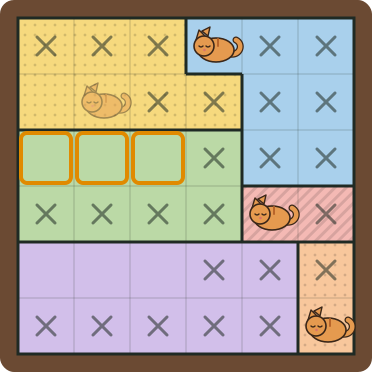
So row 2, column 2 is an ×. That leaves row 2, column 1 for the cat.
The “what if” test is your tool for when nothing else works. Picture a cat on a square. If it would leave any row, column or color with no room at all, cross that square out.
Step 4: Finish the board
Each new cat now leaves just one choice for the next:
- Row 3: the cat in row 2, column 1 touches row 3’s columns 1 and 2. Only column 3 is left.
- Row 5: the only column still free is column 2, and it’s lavender, which still needs a cat.
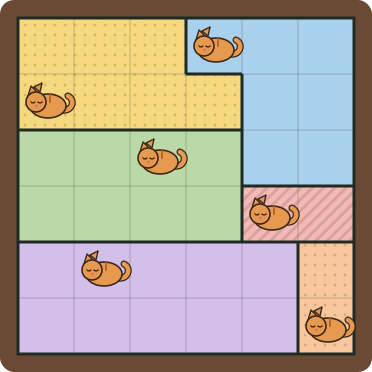
Check it: one cat in every row, every column and every color, and no two cats touching. Solved.
The three moves to remember
- Region in one line. If a region fits inside a single row or column, cross out the rest of that row or column.
- Only one square left. When a row, column or region has a single open square, the cat goes there. Then cross out around it.
- What if? Picture a cat on a square. If that would leave any row, column or color with no room, cross the square out.
Most beginner boards can be solved with just these three. Bigger boards use the same ideas, just more of them.
Practice with Porch Cats
Porch Cats starts with small 5 × 5 boards and slowly grows to 10 × 10, so you can practice these moves one level at a time. There’s no timer, undo is always free, and if you get stuck, a hint points to the next square and explains why, in plain words.