Dots and Boxes Strategy: How to Win More Games
November 4, 2026
The best Dots and Boxes strategy comes down to three habits. Never draw the third side of a box if you can help it. Count the long chains as the board fills up. And when your opponent opens a chain, take all of it but two boxes, so they have to open the next one for you.
Most people only know the first habit. The other two are why some players seem to win every game on the last few moves.
The rules in one minute
- Two players take turns drawing one line between two dots that sit next to each other, across or down.
- If your line closes the fourth side of a box, the box is yours and you draw again. One line can close two boxes at once.
- When every line is drawn, the player with more boxes wins. On a board with an even number of boxes, a tie is possible.
In Porch Duels you can play on three board sizes: 3 × 3, 4 × 4 or 5 × 5 boxes. Start small. The ideas below are easiest to see on the 3 × 3 board.
Habit 1: Never draw the third side
A box with three sides drawn is a gift. Your opponent draws the fourth side, takes the box and moves again.
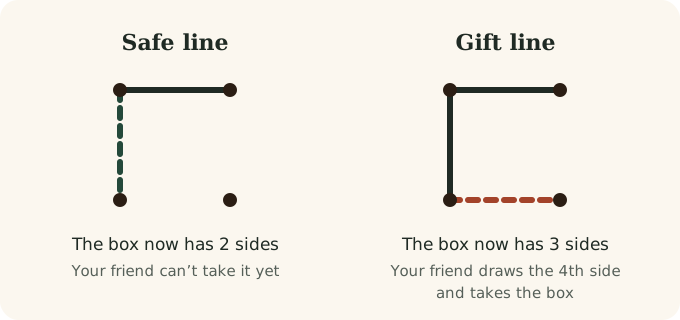
Early in the game, there are plenty of safe lines. Before each move, check both boxes next to the line you want: if either one would end up with three sides, pick another line.
Why the game is really about chains
Sooner or later, the safe lines run out. Every box has two sides drawn, and the boxes are linked into chains: rows or snakes of boxes where one line opens the whole thing. Whoever takes the first box of a chain can keep going, one box after another, to the end.
A chain of three boxes or more is called a long chain. Short chains of one or two boxes matter less, because they don’t give much away.
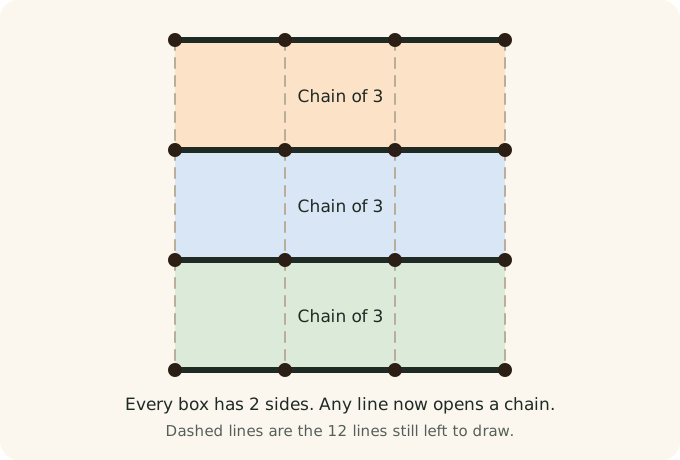
On the board above, all 12 lines left will open a chain. The player who has to move now is in trouble, and the next trick shows why.
Habit 2: Take all but two
When your opponent opens a long chain, the obvious move is to take every box. Sometimes that is right. But then you have to draw another line, and that line often opens the next chain for them.
Strong players do something else. They take all the boxes except the last two, then draw the line at the far end of the chain instead of the line in the middle.
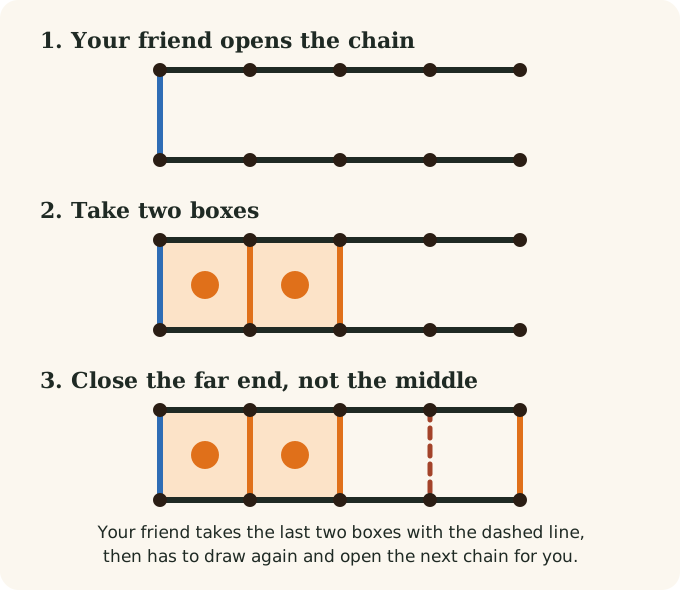
- Your opponent draws a line that opens a chain of four.
- You take two boxes, one line each.
- Now draw the far end line. It closes no box, so your turn ends.
- Your opponent takes the last two boxes with one line in the middle. Then they must draw again, and the only lines left open another chain. You get that whole chain.
You give up two boxes to win control. In a chain of three, you take one and give two. That sounds like a bad deal, but the next chain usually pays it back and more.
When not to do it: if this is the last chain on the board, just take every box. There is nothing left to win control of.
A worked example on the 3 × 3 board
Look again at the board with three chains of three. Twelve lines have been drawn and no boxes taken, so it is the first player’s turn. Let’s call the players Ann (first) and Bob.
- Ann has to open a chain. Bob takes one box and gives back two using the far end line. Bob 1, Ann 0.
- Ann takes the two boxes, then has to open the second chain. Bob again takes one and gives two. Bob 2, Ann 2.
- Ann takes two more and has to open the last chain. Bob takes all three. Bob 5, Ann 4.
Bob wins even though Ann took more boxes in the middle of the game. Ann lost because she was the one who had to open the first long chain.
Habit 3: Count the long chains
So how do you make sure your opponent opens the first long chain? Expert players use a counting rule, often called the long chain rule. It looks at the number of dots on the board and the number of long chains that will form.
Here is what it means for the Porch Duels boards:
| Board | Dots | First player wants | Second player wants |
|---|---|---|---|
| 3 × 3 boxes | 16 | An even number of long chains | An odd number |
| 4 × 4 boxes | 25 | An odd number of long chains | An even number |
| 5 × 5 boxes | 36 | An even number of long chains | An odd number |
In the example above, the 3 × 3 board had three long chains, an odd number, so the second player (Bob) came out on top.
You don’t need to count from the first move. Start counting in the middle of the game, when the board begins to settle into chains. If the count is wrong for you, try to join two chains into one or cut a chain in two with your next safe lines. Each of those changes the count by one.
A loop is a chain that closes on itself, like a ring of boxes. Loops don’t count in the rule. If your opponent opens a loop, take all the boxes but four, leaving two pairs.
More tips that win boxes
- Keep the safe lines going. The longer you can make safe moves, the more time you have to fix the chain count.
- Short chains are bargaining chips. When you have to give something away, give the shortest chain on the board, one or two boxes.
- Give a 2-box chain the smart way. Draw the line in the middle of the two boxes, not at the end. Then your opponent can’t use the all-but-two trick on it.
- Keep track of the score. If you are far ahead, you can afford to give away a small chain to keep control.
Practice against the computer
The habits above are easier to learn by playing than by reading. Our free app Porch Duels, coming soon to iPhone, iPad and Android, has Dots and Boxes on all three board sizes, with a computer opponent at three levels and big, clear lines. You can also undo a move and try the other line to see what happens. Learn more on the Porch Duels page.
Porch Duels has five other classic games for two, too. If you want a quieter game to learn next, try our guide to how to play Mancala.