How to Play Mancala: Rules, Best First Move and Strategy Tips
Updated November 13, 2026
Mancala is a game for two players on a board with two rows of six pits and a big store at each end. On your turn, you scoop up all the seeds from one of your pits and drop them one at a time around the board. The player with the most seeds in their store at the end wins.
There are hundreds of mancala games around the world. This guide covers the version most Americans grew up with, often called Kalah, with four seeds in each pit.
Quick summary
- Setup: 4 seeds in each of the 12 small pits. Both stores start empty.
- Your turn: pick up every seed in one pit on your side and drop one seed in each pit to the right, going counter-clockwise.
- Your store counts, theirs doesn’t: drop a seed in your own store as you pass it. Skip the other player’s store.
- Extra turn: if your last seed lands in your store, go again.
- Capture: if your last seed lands in an empty pit on your side, and the pit across has seeds, take both into your store.
- The end: when one side is empty, each player puts the seeds left on their side in their own store. Most seeds wins.
Setting up the board
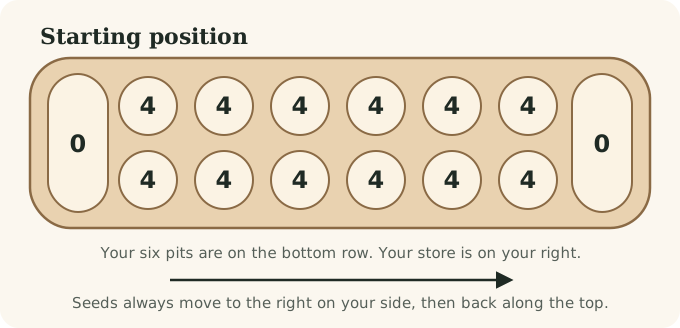
Sit across from each other with the board long side between you. The row of six pits closest to you is yours. Your store, sometimes called your mancala, is the big pit on your right.
Put four seeds in each small pit, 48 seeds in all. Leave both stores empty.
How a turn works
- Choose any pit on your side that has seeds in it.
- Pick up all the seeds from that pit.
- Moving to the right, drop one seed in each pit you come to. This is called sowing.
- When you reach your store, drop a seed in it too, then keep going along the other player’s row.
- If you come to the other player’s store, skip it.
You can never start from the other player’s side, and you can never take seeds back out of a store.
Landing in your store: take another turn
If the very last seed you drop lands in your own store, you get another turn right away. You can chain several of these in a row.
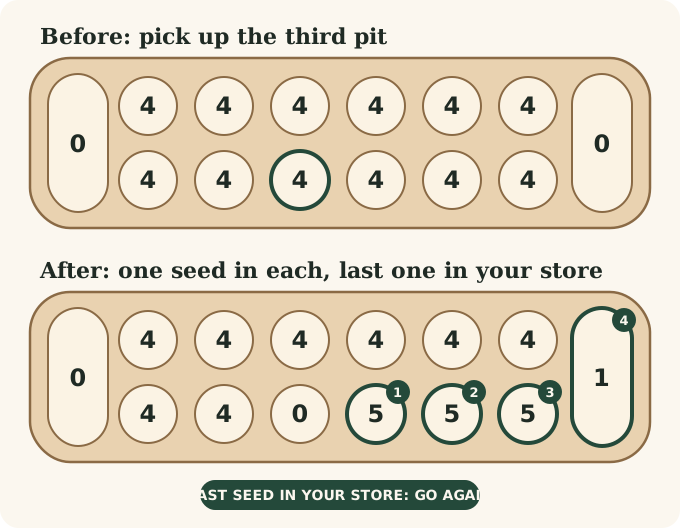
Here is the classic first move. Your third pit has four seeds, so they land in the next three pits and your store. You score one seed and go again.
A quick way to spot these moves: count how many pits a pit is from your store. If it holds exactly that many seeds, the last one lands in your store.
Capturing seeds
If your last seed lands in an empty pit on your own side, look straight across the board. If the other player’s pit there has seeds, you capture them. Put those seeds and your one seed into your store.
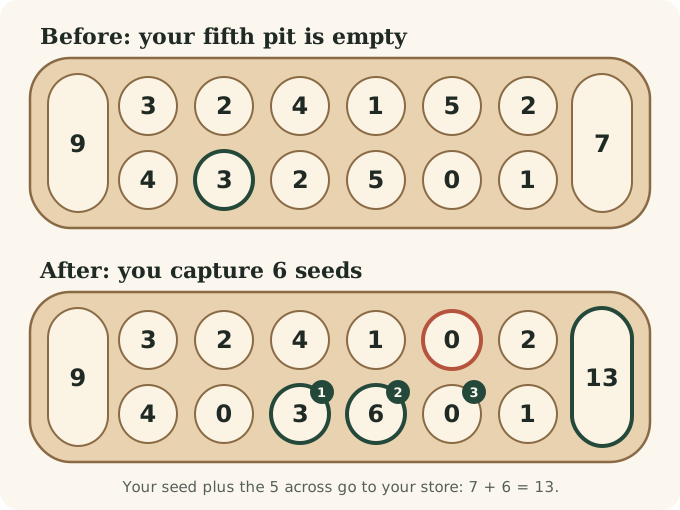
If the pit across is empty, nothing is captured and your seed simply stays where it landed. A last seed that falls in an empty pit on the other player’s side doesn’t capture anything either.
How the game ends
The game ends as soon as all six pits on one side are empty. Each player then moves the seeds still on their own side into their own store. Count the stores, and the bigger one wins. A tie is possible but rare.
That last sweep matters. If you run out of seeds first, the other player keeps everything left on their side, so an empty side isn’t always good news.
Common questions
Who goes first? Flip a coin or let the younger player start. Going first is a small advantage, so take turns starting each new game.
Do you put seeds in the other player’s store? No. Skip it every time you pass it.
Can you move seeds from your store? No. Once seeds are in a store, they stay there.
What if I can’t move? You always can until your side is empty, and an empty side ends the game.
Are there other rules? Yes, many families play a little differently. Some use three seeds per pit for a shorter game, and some don’t allow a capture when the pit across is empty, or let the player who empties their side keep the leftover seeds. Agree on the rules before you start.
Best first move in mancala
With four seeds in each pit, most players open from their third pit. The four seeds land in the next three pits and your store, so you score a seed and take another turn. On that free turn, many players then play their last pit (the one next to the store), which now holds five seeds. One seed goes in your store and the rest go to the other side.
If you play second, look first at what your opponent left: a capture or an extra turn of your own is usually worth more than copying their opening.
Mancala strategy for beginners
- Look for extra turns first. A move that ends in your store is almost always good, especially if it sets up another one.
- Play from the right before the left. Pits close to your store are easiest to land in your store. Using them early often opens new extra turns.
- Watch your empty pits. An empty pit on your side across from a full pit is a capture waiting to happen. Look for a move that ends there.
- Watch the other player’s empty pits too. Before you move, check whether your move leaves a big pile across from one of their empty pits.
- Keep a pile for later. Late in the game, a pit with many seeds can carry seeds around the board and keep them away from the other player’s sweep.
Play mancala on your phone
Mancala is one of the six games in Porch Duels, our free app of classic games for two, coming soon to iPhone, iPad and Android. You can share one phone across the table, play the computer at three levels, or play a grandchild online with a room code. The board is big and easy to read, the rules have pictures, and you can undo a move while you’re learning.
If you like games where you plan a few moves ahead, try Porch Cats, our calm logic puzzle with sleepy cats.